




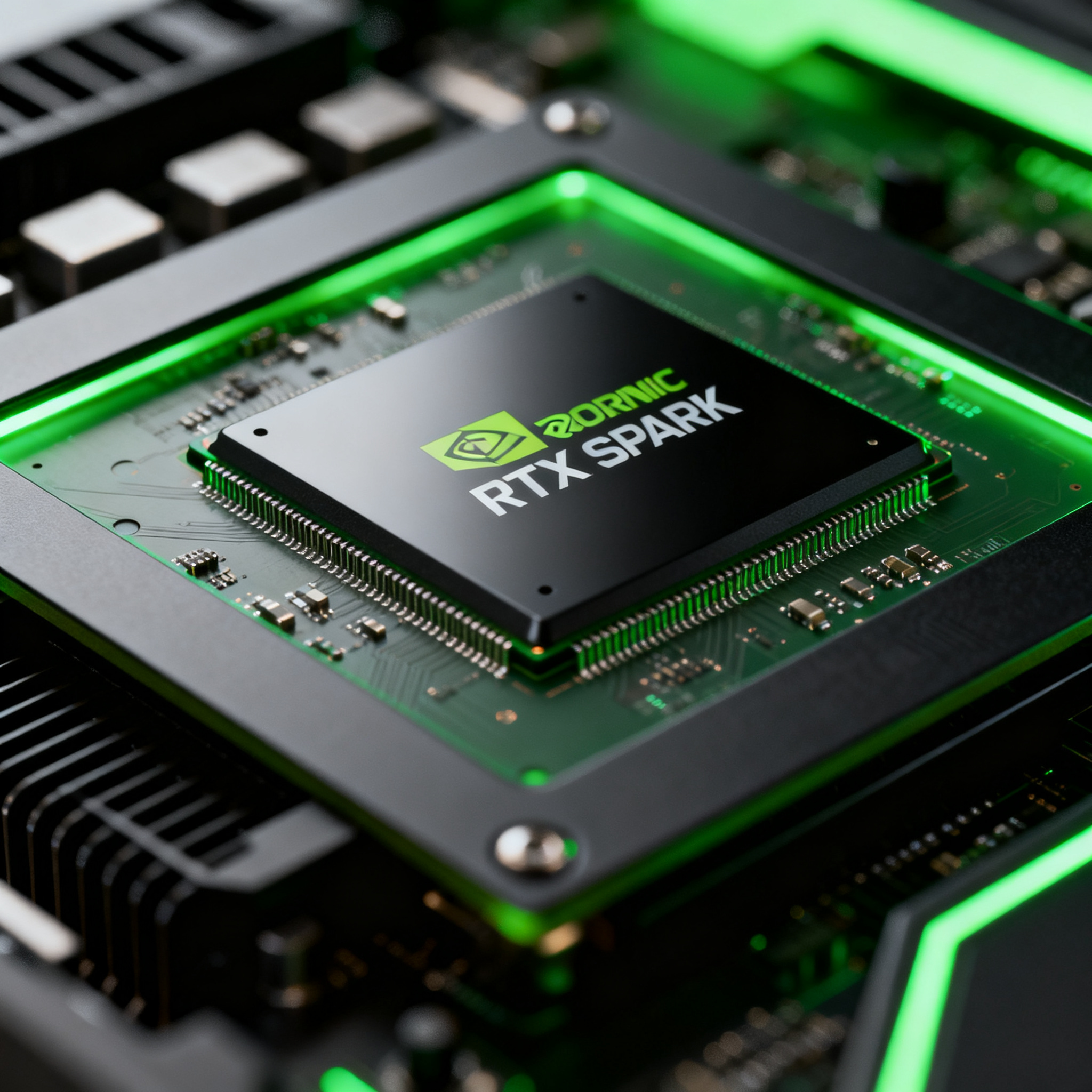
NVIDIA RTX Spark is the most significant PC hardware announcement in years. Announced at Computex 2026 on June 1, this superchip combines a 20-core ARM CPU with a Blackwell GPU and up to 128GB of unified memory — all in a single chip that fits in a slim laptop. It can run 120-billion-parameter AI models entirely on-device without sending data to the cloud. This guide explains what it is, how it compares to alternatives, when it ships, and whether you should buy one.
What Is NVIDIA RTX Spark?
RTX Spark is not a GPU upgrade — it is an entirely new PC platform. NVIDIA partnered with Microsoft and MediaTek to create a single chip that combines a CPU, GPU, and memory into one unified package. Instead of the traditional PC design where the CPU and GPU have separate memory banks and must copy data between them, RTX Spark shares all 128GB of memory between both processors.
This matters because running large AI models requires massive amounts of fast memory. Before RTX Spark, running a 120B-parameter model locally required a multi-GPU server costing $10,000+ or a Mac Studio at $4,000-7,000. With RTX Spark, the same capability fits in a thin Windows laptop or compact desktop that also runs games and creative apps.
The chip is built on TSMC’s 3nm process with 70 billion transistors. Key specs include:
- CPU: 20-core NVIDIA Grace ARM processor (10 performance + 10 efficiency cores)
- GPU: Blackwell RTX with 6,144 CUDA cores (equivalent to desktop RTX 5070)
- Tensor Cores: 5th generation with FP4 precision
- Memory: Up to 128GB unified LPDDR5X (300 GB/s bandwidth)
- AI performance: 1 petaflop (1,000 trillion operations per second)
- NVLink-C2C: 600 GB/s chip-to-chip interconnect between CPU and GPU
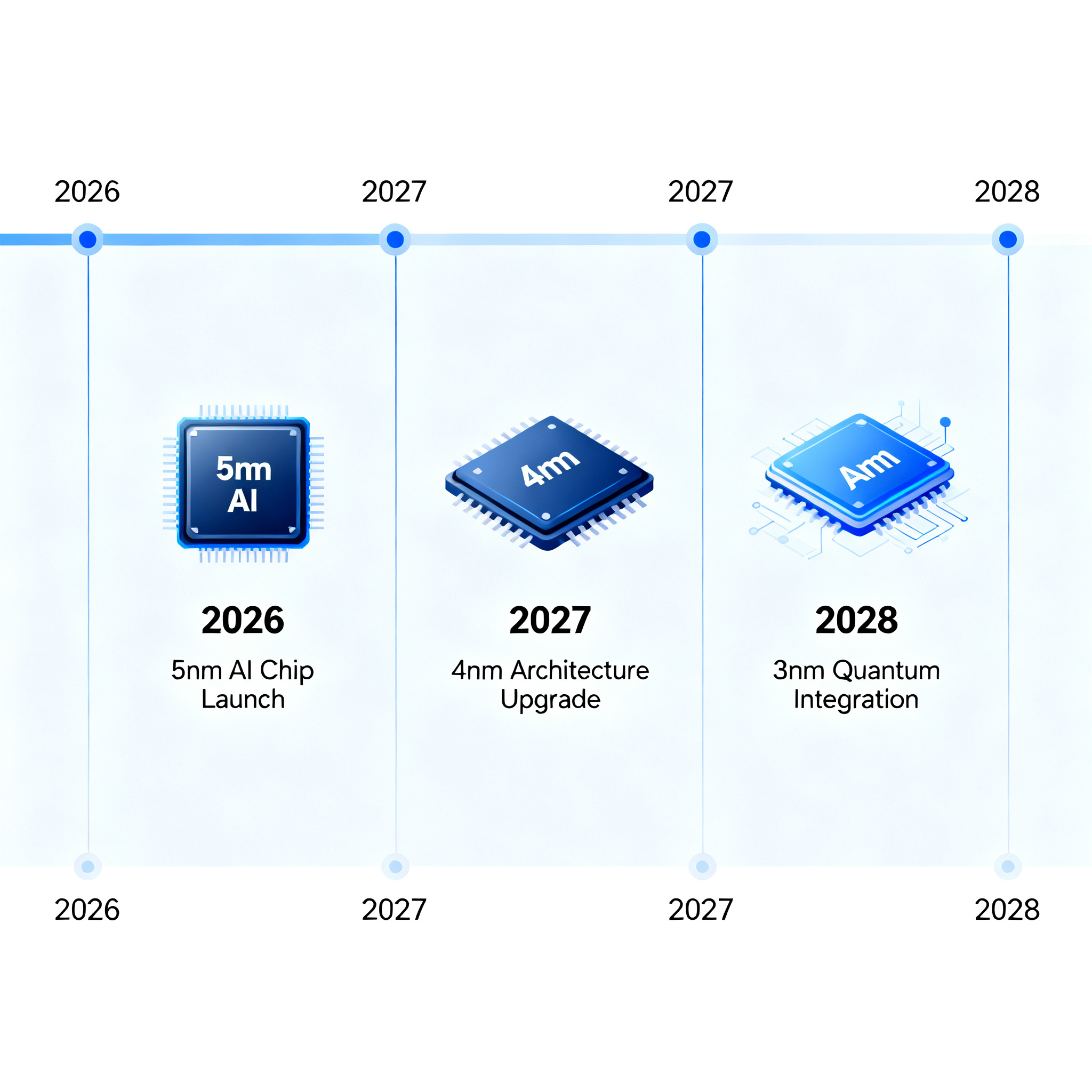
NVIDIA has confirmed at least two follow-on generations (N2X and N3X), ensuring the platform has a multi-year roadmap.
RTX Spark Specs in Plain Language
The numbers are impressive, but here is what they mean in practice:
128GB Unified Memory Is the Key Feature
Traditional PCs have separate RAM (16-64GB) and GPU VRAM (8-24GB). Data must travel between them, creating a bottleneck. RTX Spark’s unified memory means the CPU and GPU access the same 128GB pool instantly. This allows loading models that would otherwise require expensive server GPUs.
1 Petaflop of AI Performance
This is enough to run 120B-parameter models at interactive speeds. For comparison, a desktop RTX 4090 delivers approximately 82 teraflops. The RTX Spark delivers over 12x that for AI-specific workloads thanks to its 5th-gen Tensor Cores and FP4 precision.
Windows on ARM with CUDA Support
RTX Spark runs Windows on ARM with full CUDA support out of the box. This means every AI tool that works on NVIDIA hardware — Ollama, LM Studio, vLLM, ComfyUI, PyTorch — runs natively. WSL2 ships with GPU passthrough pre-configured, so developers can start working immediately.
RTX Spark vs Mac Studio vs DGX Spark: Which Is Better?
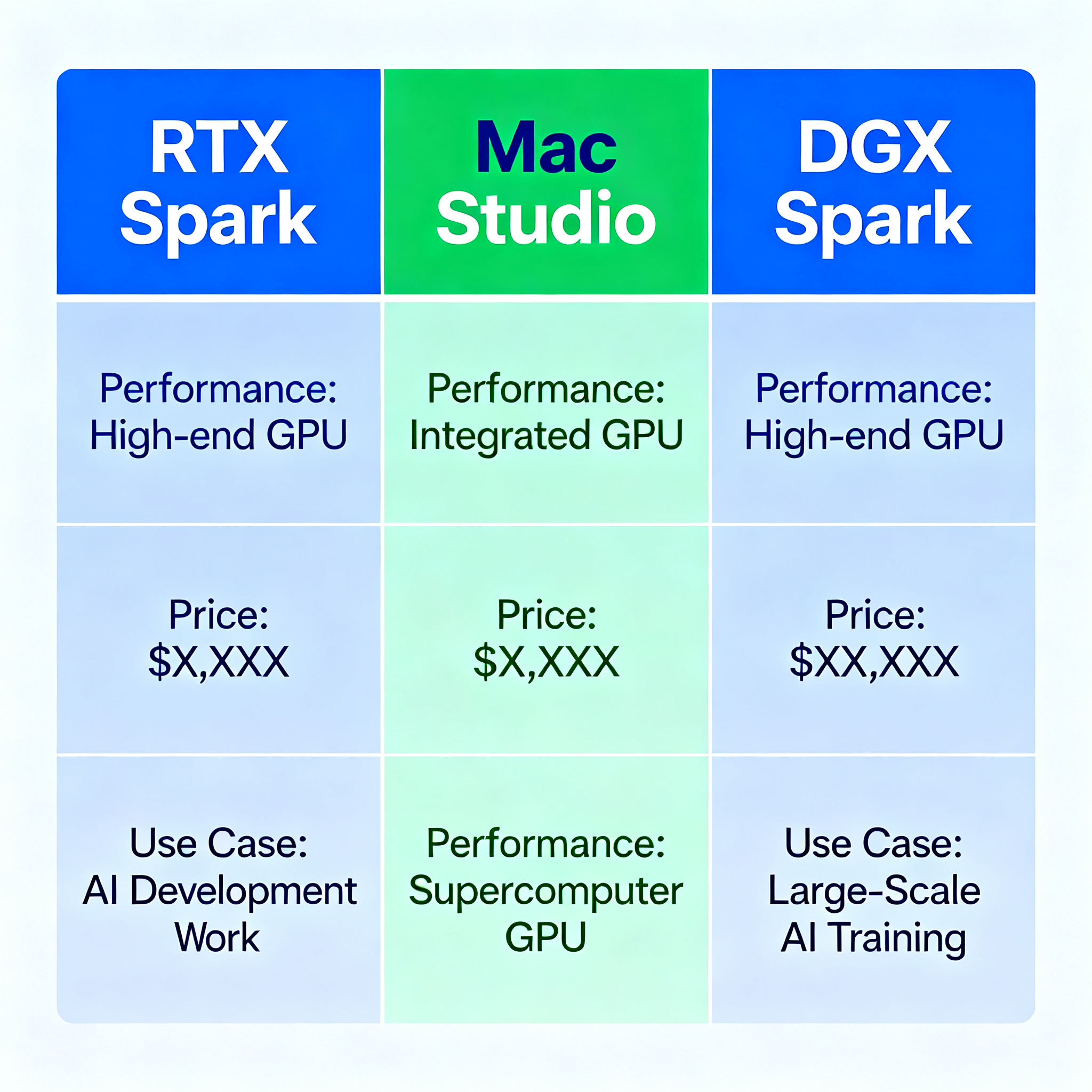
| Specification | RTX Spark (Windows PC) | Mac Studio M4 Ultra | DGX Spark (Linux) |
|---|---|---|---|
| Unified Memory | 128GB | Up to 192GB | 128GB |
| AI Compute | 1 PFLOP FP4 | ~27 TFLOPS | 1 PFLOP FP4 |
| Max Local Model | 120B params | ~140B params | 200B inference |
| Operating System | Windows 11 | macOS | DGX OS (Linux) |
| CUDA Support | ✅ Native | ❌ | ✅ Native |
| Form Factor | Laptops + Desktops | Desktop only | Desktop workstation |
| Also Runs | Windows + AAA games | macOS apps | Headless dev |
| Price (est.) | $1,799 – $2,899 | $4,000 – $7,000 | $3,000 – $5,000 |
| Availability | Fall 2026 | Available now | Available now |
What AI Models Can Run on RTX Spark?
With 128GB of unified memory, RTX Spark can run a wide range of open-source models at high quantization levels:
| Model | Parameters | Memory Needed | Runs on RTX Spark? |
|---|---|---|---|
| Qwen 3.6 27B | 27B | ~16GB (Q4) | ✅ Easily |
| Llama 4 Scout | 109B (17B active) | ~60GB (Q4) | ✅ Fits comfortably |
| Llama 3.3 70B | 70B | ~40GB (Q4) | ✅ Fits well |
| DeepSeek V4-Pro | 1.6T | 200GB+ | ❌ Too large |
The sweet spot is models up to 70B at FP16 or 120B at Q4 quantization. MoE models like Llama 4 Scout where only a portion of parameters are active per query run particularly well.
Who Should Buy RTX Spark? (Decision Guide by Persona)
Here is a practical guide for different types of users:
AI Developers and Researchers
Yes, buy it. If you regularly run local models, experiment with open-source LLMs, or need privacy-bound inference for client work, RTX Spark is the first Windows machine purpose-built for your workflow. The CUDA ecosystem, WSL2 integration, and OpenShell security layer make it a genuine alternative to cloud GPU rentals.
Creative Professionals
Consider it. RTX Spark renders 90GB+ 3D scenes, edits 12K video, and generates 4K AI video — all in a laptop form factor. If you currently compromise between mobility and desktop power, this is a real upgrade.
Enterprise and Compliance-Heavy Professionals
Yes, for privacy. Healthcare, legal, and finance professionals who cannot send sensitive data to cloud APIs can now run 120B models locally with full data control. The OpenShell runtime enforces data masking, sandboxing, and policy controls.
General Power Users
Wait for reviews. If you primarily use cloud AI services (ChatGPT, Claude) and are happy with them, RTX Spark solves a problem you do not have. Wait for real-world benchmarks and pricing from OEMs.
RTX Spark Availability, Price, and Timeline
Availability: Fall 2026. PCs will ship from ASUS, Dell, HP, Lenovo, Microsoft Surface, and MSI. A Surface RTX Spark Dev Box (pre-configured for AI developers) is also planned.
Price: Not officially announced. Analyst estimates point to $1,799 for the base N1 configuration and $2,899 for the higher-end N1X config. A Morgan Stanley note cited these figures — treat them as estimates until OEMs announce real SKUs.
Form factors: Laptops as slim as 14mm and as light as 3 pounds, plus compact desktops. NVIDIA confirms 14- to 16-inch designs with tandem OLED and G-SYNC displays.
Generations: NVIDIA has confirmed N2X and N3X follow-ons, ensuring platform longevity through 2028+.
The Bigger Picture: What RTX Spark Means for Local AI
RTX Spark represents a structural shift in who can run serious AI models locally. Before RTX Spark, running 70B+ models required a multi-GPU server, a Mac Studio, or cloud GPU rentals. After RTX Spark, a Windows laptop at $1,800-2,900 can do the same job.
This accelerates the trend away from API dependence. When you can run Llama 4 Scout or Qwen 3.6 27B locally with no per-token cost and full privacy, the economics of local vs cloud change dramatically. The break-even point for heavy AI users shifts from months to weeks.
The market response on announcement day was telling: NVIDIA stock rose 4%, while Intel fell 3.1%, AMD fell 3.2%, and Qualcomm dropped 8.78% — the steepest single-day decline for Qualcomm in months. Investors clearly see this as a market redefinition.
Frequently Asked Questions
What is NVIDIA RTX Spark?
RTX Spark is a superchip combining a 20-core ARM CPU with a Blackwell GPU and up to 128GB unified memory in a single package. It is designed to run large AI models (up to 120B parameters) locally on Windows PCs.
When does RTX Spark launch?
Fall 2026. PCs from ASUS, Dell, HP, Lenovo, Microsoft Surface, and MSI will ship. Pricing is estimated at $1,799-2,899.
Can RTX Spark run games?
Yes. The Blackwell GPU is equivalent to a desktop RTX 5070 with ray tracing, DLSS, and G-SYNC support. It handles AAA titles at 1440p 100+ fps.
How does RTX Spark compare to Apple Silicon?
RTX Spark has CUDA support (critical for AI tools), laptop form factors, and likely lower pricing. Mac Studio offers up to 192GB memory and a mature macOS ecosystem. Both are excellent for local AI — choice depends on your OS preference and software stack.
Can I run DeepSeek V4-Pro on RTX Spark?
No. DeepSeek V4-Pro has 1.6T total parameters and requires 200GB+ even at high quantization. RTX Spark’s 128GB memory can handle models up to approximately 120B parameters.
Will RTX Spark run Ollama and LM Studio?
Yes. Ollama (uses llama.cpp), LM Studio, vLLM, and ComfyUI are all planned for launch-day support, with NVIDIA-optimized performance gains.
Conclusion
NVIDIA RTX Spark is a genuine PC industry milestone. It brings 120B-parameter AI model capability to consumer laptops and desktops at consumer prices. For AI developers, privacy-bound professionals, and creative workers, it offers a compelling combination of local AI power, Windows compatibility, and laptop mobility that has not existed before.
Whether you should buy one depends on your use case. Developers running local models daily will find it transformative. Casual AI users should wait for real-world reviews and confirmed pricing. Either way, RTX Spark marks the beginning of a new era in personal computing — one where powerful AI is built into the machine on your desk, not accessed through a cloud subscription.
Related:
Run Local AI Models 2026 |
How to Run AI Locally on Your Laptop
About the author: Research by the tonkonwslist.com editorial team. This article is based on NVIDIA’s Computex 2026 keynote, Microsoft’s Build 2026 announcements, and published coverage from industry analysts. Sources:
AIMadeTools Complete Guide,
RohitRaj Developer Notes,
WeVint Analysis